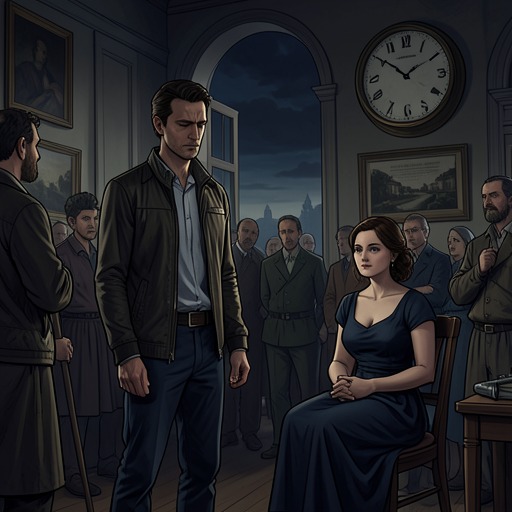
Saladin Chamcha’s metamorphosis into a goat-like being
The Satanic VersesSaladin Chamcha’s metamorphosis into a goat-like being makes bodily change both an intimate ordeal and a public image: as his human appearance deteriorates in the attic above the Shaandaar Café, London begins to imagine him as a figure of menace, resistance, and power. The transformation is not presented as a simple change of costume or a resolved supernatural puzzle. It progresses through physical symptoms, frightened encounters, theories of mutation, and the circulation of dreams, while Saladin struggles to recognize the self emerging from a body he did not choose.
Arrival and First Interpretations
Jumpy Joshi brings Saladin to the Shaandaar rooming house late at night. Saladin is shivering and nearly speechless, with horns already visible beneath the borrowed sheepskin jacket and a blanket wrapped around goat-like hooves. The combination of the jacket’s sheep curls and the pointed horns makes his altered body appear at once comic and alarming. He is sluggish, dull-eyed, and passive, unable to give his own account of what has happened; Jumpy must tell the story of his fall from the sky while Saladin drinks chicken soup and remains absorbed in his misery.
Muhammad Sufyan, the proprietor and former schoolteacher, meets the crisis with a mixture of scholarship and practical care. Woken by Jumpy’s knock, he recognizes the horns and makes an impromptu comparison with Lucius Apuleius, whose account of transformation into an ass supplies a literary precedent. Sufyan recalls that Apuleius’s return to human form required the intervention of Isis, but turns quickly from classical analogy to a bowl of hot soup as the immediate remedy. His wit does not deny the distress before him: he places Saladin at a table and treats the newcomer as someone who needs warmth and help.
The residents’ night-time crisis meeting gives the transformation a second, more theoretical interpretation. After Jumpy recounts Saladin’s fall, Sufyan invokes Lamarck and the final edition of Darwin’s The Origin of Species, considering mutation in extremity and the difficulty of understanding what use a particular change might have. Anahita Sufyan cuts through her father’s abstract discussion with the more immediate question of how Saladin became such a freak. The exchange sets competing ways of seeing the altered body beside one another: as a problem for evolutionary thought, an inexplicable spectacle, and a person’s urgent condition.
The Body’s Continuing Change
At first, Saladin’s visible features make the transformation difficult to mistake. As weeks and months pass in the attic, his condition worsens. His horns, after a brief diminution that no one observes, thicken and lengthen into curling shapes around his head. They form a darkening, bone-like turban, making the change both more pronounced and harder to conceal. Hair grows long on his face and spreads over the rest of his body; a tail sprouts at the base of his spine and lengthens until ordinary trousers are no longer practical. Anahita finds him baggy salwar pantaloons from her mother’s clothes, which he uses to cover the new limb.
The change reaches beyond outward appearance into appetite and habit. Saladin, formerly particular about food, finds that different foods begin to taste much the same. At times he catches himself nibbling at bedsheets or old newspapers, then stops with a start, ashamed at what he understands as further movement away from manhood and toward goatishness. He needs increasing amounts of green mouthwash to control his breath. These details make the transformation an accumulating daily experience rather than a single miraculous instant: clothes must be changed, eating becomes unfamiliar, and even an ordinary bodily routine offers evidence of estrangement.
His heart, too, seems to join the mutation. Sleepless in the narrow bed, with his horns snagging on sheets and pillowcases as he turns, Saladin feels it kick and stumble. Its formerly regular beat gives way, in his perception, to the unpredictable rhythms of tabla improvisation. The bodily disturbance merges with the altered world he apprehends around him: London becomes, in his night-time vision, a hell called Jahannum, Gehenna, or Muspellheim. The imagined city and the changing body echo one another, though the scene leaves the distinction between physical event and disturbed perception unresolved.
Confinement, Care, and Refusal
The attic offers Saladin shelter but also encloses him within the change. Sufyan tells him that the house is the best place to heal his disfigurements and recover his normal health, among people he describes as Saladin’s own kind. Alone later in the attic, Saladin rejects that assurance: he insists that the Sufyans are not his people and that he has spent half his life trying to get away from them. His answer gives the bodily transformation a history of its own. The crisis does not erase the distance he has cultivated from the people around him; being dependent on their care makes that distance newly immediate.
Sufyan remains solicitous even as the condition continues. When he suggests that a mullah might be able to end the apparent possession of Saladin’s body, Saladin reacts with startling violence: he springs up, raises his arms, and fills the room with dense, sulphurous smoke and a piercing, high-pitched sound. He then opens a window, tries to clear the fumes, and apologizes in embarrassment, unable to explain what came over him. The episode makes the possibility of religious intervention fraught rather than reassuring. The reaction is powerful, but Saladin himself does not claim command over it, and the scene offers no cure.
The distinction between refuge and captivity grows sharper as time passes. When alone, Saladin periodically loses consciousness, as if running down, and his body makes alarming sounds during these intervals. He grows in the periods of stillness, often just before visitors arrive. The change is therefore both concealed and socially exposed: the attic keeps him out of sight for a time, but his increasing size and the noises associated with it make secrecy less and less sustainable.
From Private Dream to Public Image
Before a public story about the attic can fully emerge, Saladin begins appearing in other people’s dreams. The dreamers include local religious figures, Uhuru Simba, Mishal Sufyan, Jumpy, Hanif Johnson, a bus conductor, and eventually the formerly silent man who has not spoken since being threatened with a knife in a restaurant. The dreams recur in sequence, one night following another. Their Saladin is enormous and horned, rising in the street and seeming to burn the town; he sings, but the words are too guttural and distorted for the dreamers to identify. Even the silent man sits up in sleep and sings in an alien, static-filled voice that his wife cannot understand.
The same dream image carries opposing meanings across London. Non-tint neo-Georgians dream of a sulphurous enemy crushing their restored homes, while Black and brown dreamers cheer the figure as someone shaped by race, history, and misfortune who has become capable of striking back. The discrepancy is not a change in Saladin’s body so much as a change in the meaning assigned to it. A terrifying creature to one group becomes a defiant hero to another, and the racial division in these responses turns the dream figure into a focus for conflicting fears and hopes.
The image soon escapes the dreams. Retailers and manufacturers sell badges, sweatshirts, and posters; the horned figure appears on young people’s clothing and in shop windows protected by metal grilles. Children wear rubber horns, and a raised-fist Goatman turns up on banners at political demonstrations. Police community-relations officers describe the trend as a devil cult among young Black and Asian people, using the supposed Satanist revival against accusations made by Pamela Chamcha and the local community-relations council. Mishal, by contrast, urges Saladin to understand the image as something rejected by white society that people can occupy, inhabit, and reclaim. The public symbol thus becomes a struggle over who may define the monstrous and who may turn that definition into an emblem of resistance.
Growth, Agency, and the Unresolved Self
As the dream figure becomes popular, Saladin’s physical transformation continues in the attic. The city hears stories, rumours, and doubtful reports; concern about occultism becomes entangled with suspicion surrounding the killings of old women attributed to the Granny Ripper. Authorities intensify the detention and interrogation of people racialized as tints and conduct raids on establishments suspected of occultist activity. The narrative presents this widening response as part of the same unstable passage between imagination and waking life: people begin treating the dream figure as real, a being who has crossed into the city beyond its ordinary controls. Saladin is still hidden away, but the figure attached to his name is already acting in public life.
Inwardly, he considers the mutability of the self and the possibility that someone may become so other to himself as to be another person, severed from his history. He remembers Zeeny Vakil and the optimism of her ideas about eclecticism, hybridity, will, and choice, but contrasts those possibilities with the transformation overtaking him. This is newness without self-invention: not a chosen identity fashioned from available influences, but an alteration that happens to him through his condition. The distinction sharpens the cost of the metamorphosis. The new self may be powerful, but it is not a self Saladin set out to become.
Bitterness and hatred increasingly accompany his recognition of that power. He imagines himself as loud, foul, hideous, oversized, grotesque, inhuman, and strong, with force enough to topple church spires by extending a finger. Yet the growth of power does not amount to control over the transformation, nor does it resolve who is responsible for it. Saladin looks for someone to blame, while in his dreams a still-unclear face moves closer. His acceptance that he is what he is marks a moment of self-recognition, but not a recovery of his former body or a settled explanation of his new one. The metamorphosis remains at once a bodily ordeal, a break with the identity he had tried to make, and an image that other people seize for meanings of their own.